Cue-Stacking for Stubborn Vocabulary
Cue-stacking for stubborn vocabulary is useful when a foreign word keeps slipping away even though you have seen it many times. Repetition may make the word look familiar, but familiarity is not the same as being able to retrieve it when you need it.
A better approach is to make the word less isolated.
Instead of depending on one weak route, you can connect the word with sound, image, meaning, movement or context. The goal is not to pile on more material. It is to give memory something more useful to work with.
When Repetition Keeps Repeating the Same Problem
Reading the same word again and again can still mean travelling down essentially the same road.
The page is in front of you. The spelling is visible. The translation may sit beside it. Everything feels obvious because the original cues are still present.
Then the page disappears.
Now you have to find the word yourself.
That is a different task.
This is where cue-stacking for stubborn vocabulary becomes useful: instead of repeating the same cue, you give the word another meaningful point of access.
A useful memory connection gives you something that can survive beyond the original vocabulary list.
A word can be seen, spoken, heard and placed into a meaningful situation. Say it aloud and you add your own voice and pronunciation. Put it into a sentence and the word acquires context. Use a gesture or movement and the meaning can become physical. Notice a familiar sound or pattern and the word may stop looking like an anonymous string of letters.
These elements do different jobs. They do not all have to be present, and they do not all have to become separate mnemonics. Sometimes one compact connection can carry several of them at once.
What Can Steven Spielberg Teach You About German?
Suppose you are learning German.
You already know the name Spielberg.
Now look at it again.
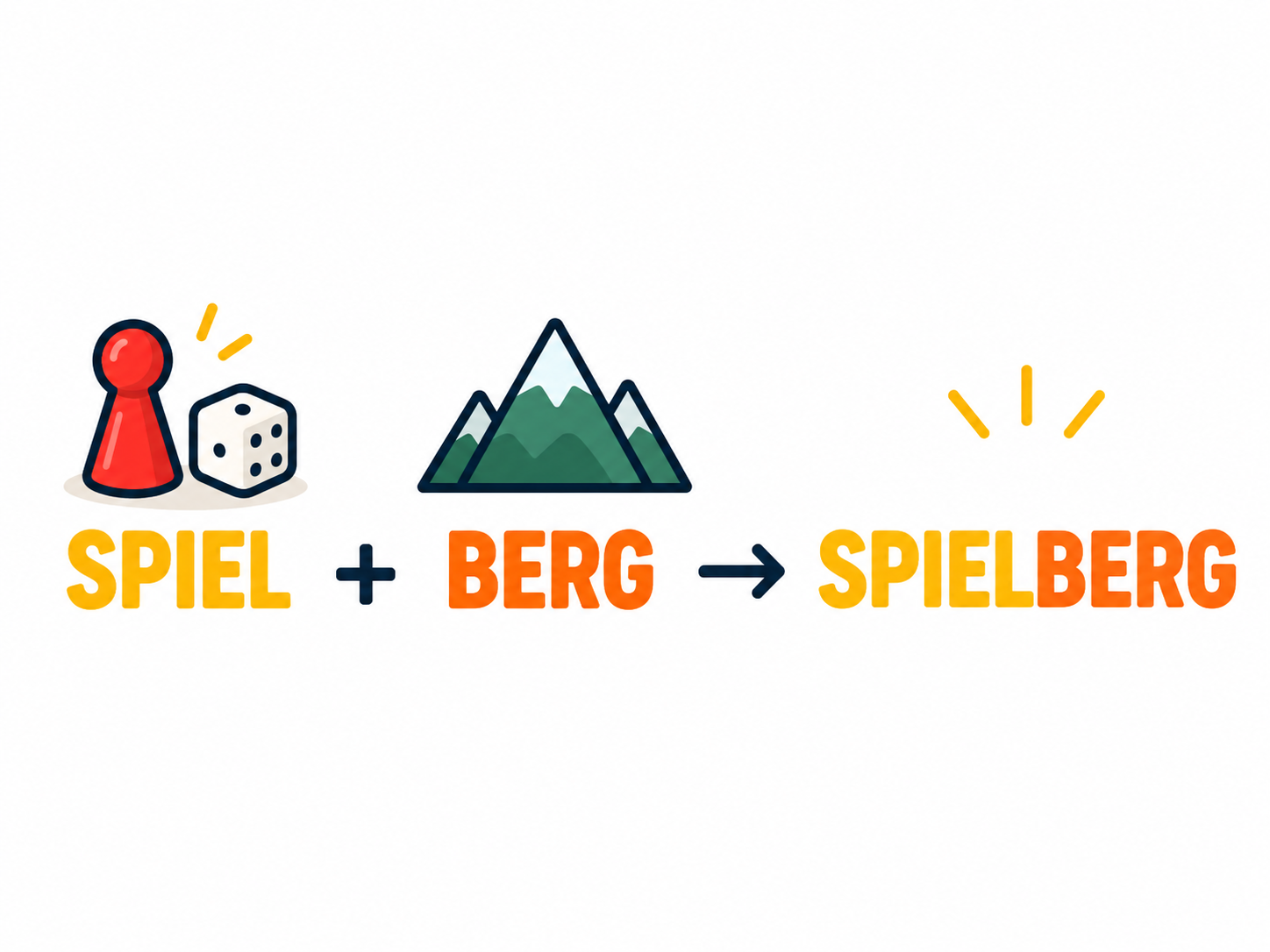
SPIEL — game or play.
BERG — mountain.
Two German words have been sitting inside a famous name all along.
Now let imagination finish the job.
Picture Steven Spielberg directing an enormous game on top of a mountain. Players are racing across the summit while cameras follow them. The scene is absurd enough to stand out, but simple enough to understand instantly.
The familiar name helps with the sound and spelling. The game gives Spiel a concrete meaning. The mountain gives Berg another.
One short scene holds the pieces together.
That is the useful surprise behind cue-stacking: several cues do not have to mean several separate memory tricks. Sound, prior knowledge, image and meaning can support one another inside a single compact experience.
You have not repeated Spiel and Berg ten times.
You have given them something to belong to.
And this suggests a more interesting question. Why always begin with the shortest, simplest-looking words? A longer compound may contain two or three useful pieces at once. Learn the whole word, notice its parts, and one memorable image may introduce you to several building blocks that will appear again in other words. In languages that build vocabulary this way, a “difficult” long word can sometimes be surprisingly economical to learn.
German makes this especially visible, but the broader habit travels across languages: look inside a word before treating it as one indivisible object. Compounds, roots, prefixes, suffixes and familiar sound patterns can all reveal information that ordinary vocabulary lists hide.
Cue-Stacking for Stubborn Vocabulary Without Clutter
More detail is not automatically better.
A vivid scene can become weaker when it is overloaded with irrelevant elements. Every added feature should earn its place.
Does it help recover the sound? Does it clarify the meaning? Does it make the word more distinctive? Does it connect the word with a situation in which you may need it?
If it does none of those things, it may simply create clutter.
Foreign vocabulary often arrives in an abstract form: letters, unfamiliar sounds, translations and definitions. Memory becomes easier to work with when some of that abstraction turns into something you can see, hear, feel or imagine happening.
The letters have not changed.
What has changed is the number of meaningful relationships attached to them.
A known name can reveal a hidden pattern. A sound can suggest an image. A sentence can supply context. Movement can make an action tangible.
The word gradually becomes less anonymous.
Use Cue-Stacking Selectively
You do not need to construct a mnemonic system around every word you encounter.
Many words become familiar naturally through reading, listening and repeated use.
Cue-stacking is most valuable for words that matter to you and continue to escape despite ordinary exposure.
That is where a little creative work can save a great deal of mechanical repetition.
Used selectively, cue-stacking for stubborn vocabulary concentrates that extra effort exactly where ordinary exposure has not been enough.
And something else begins to happen.
You stop looking at a difficult word only as something to memorize. You begin asking what is already inside it, what it resembles, what it connects with and what could make it easier to find again.
That shift in attention is part of Saper Vedere.
Go Further With Saper Vedere
Cue-stacking is only one part of a larger question: how can different kinds of information work together without turning learning into a complicated collection of tricks?
The Invisible Illusionist explores that deeper level through language, imagery, sound, movement, stories and unexpected relationships.
The aim is not simply to remember more.
It is to learn to see more.

Memory. Attention. Technology. Creativity. Hypnosis. Together, they spell MATCH.
Libor Činka, author of The Invisible Illusionist, is an Ericksonian hypnotherapist, trainer, and creator of innovative learning methods who has spent over three decades exploring how this unusual combination can make learning more engaging and longer-lasting in memory.
The Curtain Is Up — The English Edition Is Here
The Invisible Illusionist is now available in English, the first language edition. Future translations will depend on reader interest. Leave your email and choose your preferred language to help us decide which edition comes next and receive updates about its availability.
